_icon2_300_300.png?v=12724)

-
Most organizations think of FinOps as a tool to control cloud expenditure. While preventing cloud spending from getting out of hand is important, the bigger challenge is proving that the spending actually generates meaningful business value.
Short-term tactics such as rightsizing resources or adopting commitment-based discounts like Committed Use Discounts (CUDs) or Reserved Instances (RIs) will only get you so far. If the goal is to systematically turn technology investment into measurable business outcomes, businesses need an operating culture that aligns engineering, finance, product, procurement, and executive leadership around a shared model of decision-making.
This is where the FinOps Framework becomes especially valuable. It gives organizations a structured way to answer four essential questions: What Principles should guide decision-making? Which stakeholders (Personas) need to be involved? What outcomes (Domains) should the organization aim to achieve? And what Capabilities must be built to get there?

Principles
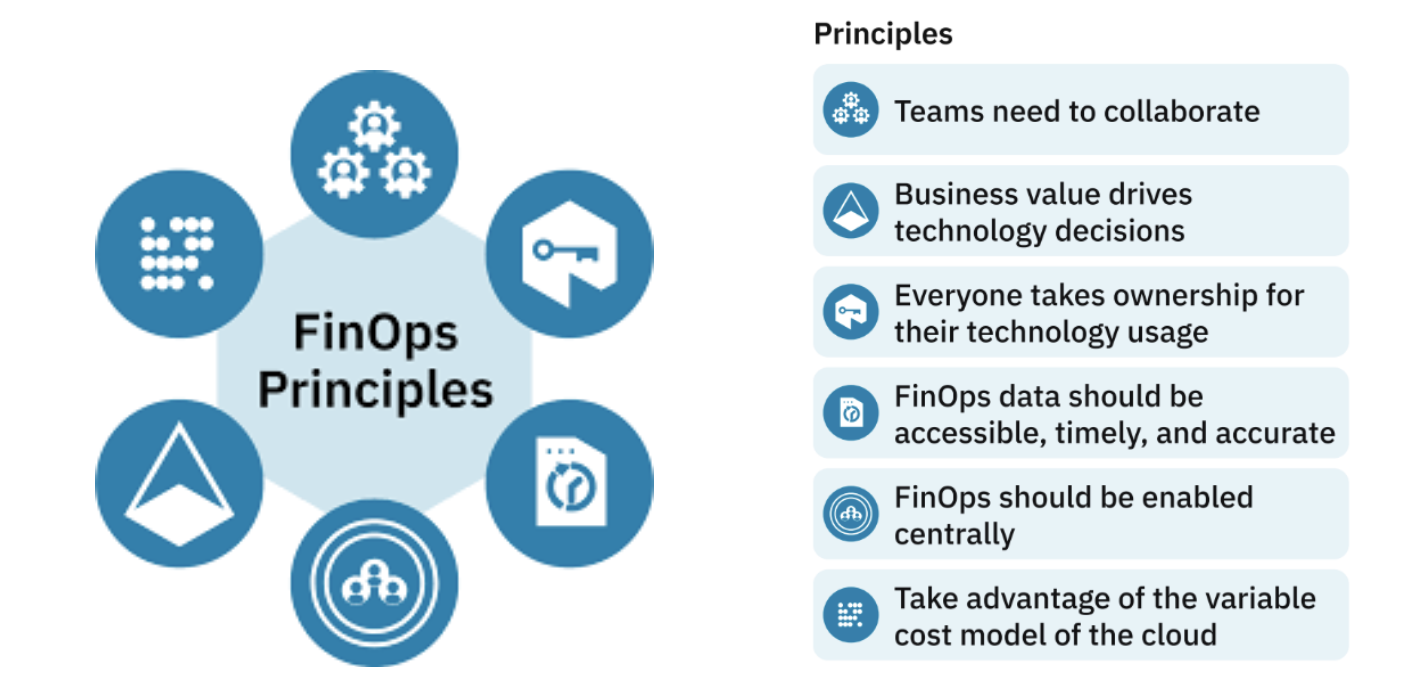
These six principles reflect three critical mindset shifts:
Change in collaboration
In traditional on-premise IT settings, investments were heavily based on fixed budgets and upfront hardware purchases. Cost could only be reviewed and managed after the fact, typically by a centralized team. However, cloud resources are billed in near real time and can scale instantly. Technical decisions are now financial decisions. That is why FinOps emphasizes that finance, engineering, product, and business teams can no longer operate with separate interpretations of data and separate definitions of success. They need to work from the same data, toward the same goals, and make decisions in a shared language.
Decentralized accountability
In cloud environments, the people who influence spending are often the ones making day-to-day choices about architecture, performance, deployment, and resource usage. That means accountability must move closer to the front lines. At the same time, the role of the central team should also change. Instead of acting as the owner of all cost decisions, it becomes an enabler, providing shared data models, governance frameworks, discount and commitment strategies, best practices, and cross-functional coordination.
Value over lowest cost
The FinOps Framework does not argue that organizations should simply spend less. Instead, it focuses on maximizing business value, encouraging teams to use value-based metrics such as unit economics to measure how cloud spend drives business results (e.g., cost per transaction). In some cases, spending more may be the right decision if it drives greater revenue, better reliability, or stronger customer outcomes. Once an organization can clearly explain how a cloud investment contributes to measurable business results, that spend stops being viewed as just an expense. It becomes a strategic investment.
Personas
Successful FinOps adoption does not depend on a single team or single tool. It is fundamentally a cross-functional operating model.
In FinOps Framework, personas represent groups of stakeholders who need to participate in decisions, share information, and take joint ownership of outcomes. In large enterprises, one persona may map to an entire department. In smaller organizations, a single person may cover multiple personas. Either way, the core idea remains the same: the right people need to make the right decisions at the right time using the same data.
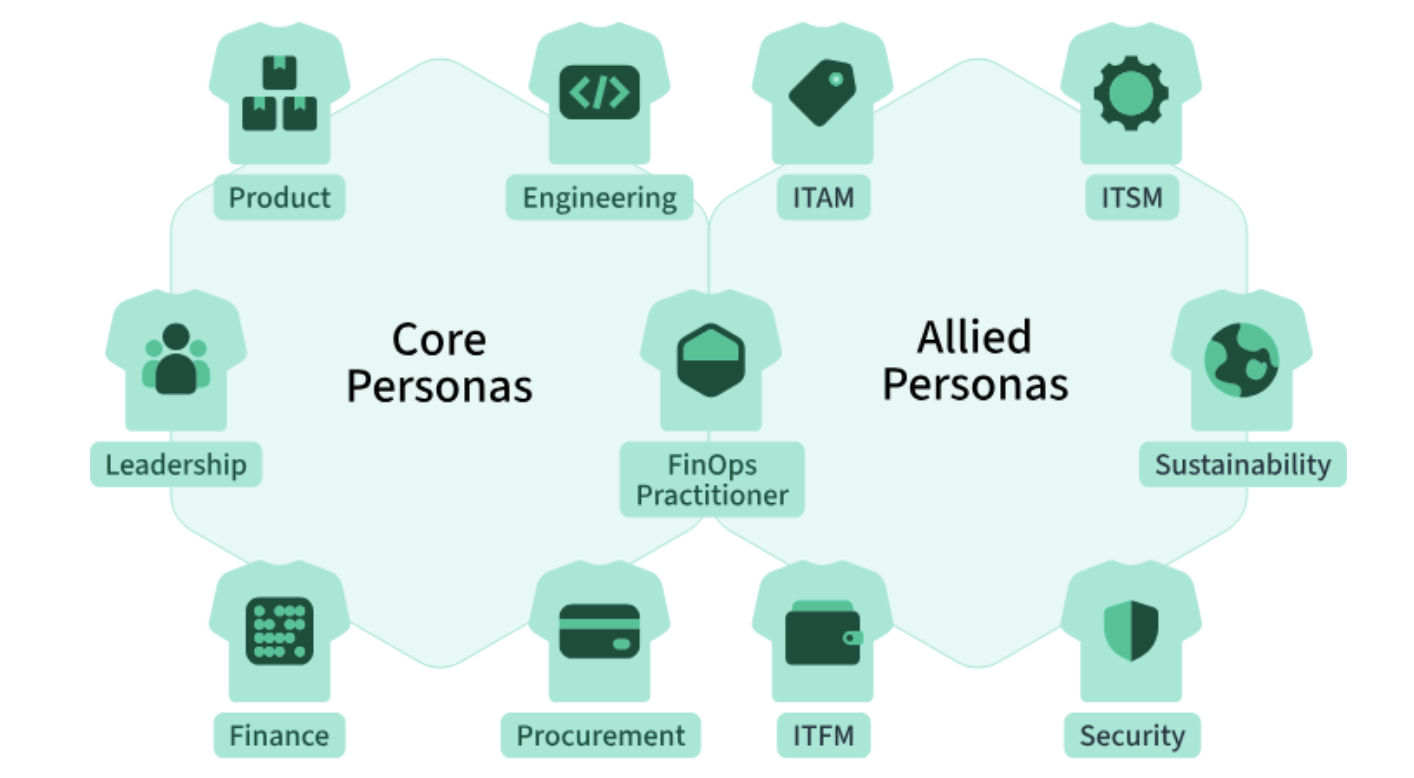
The reason FinOps often underdelivers is not because the framework is flawed, or because the tooling is weak. It is because one or more critical personas are missing from the operating model.
Take product as an example. Many organizations mistakenly treat FinOps as something owned only by finance and engineering. That leads to a narrow focus on how to reduce spending, without asking if the resources could be invested in features that generate customer value and business growth. Without product involvement, FinOps easily becomes a mere cost-cutting exercise.
Procurement is another commonly overlooked stakeholder. Even when engineering teams optimize consumption and finance closely monitor budgets, organizations can still lose significant value if no one is actively managing contracts, pricing models, commitments, and cloud vendor negotiations. Effective rate optimization requires procurement expertise; without it, organizations often leave substantial structural savings unrealized.
Leadership is equally critical. FinOps is not a side project that mid-level teams can sustain. It requires strong executive sponsorship to drive systemic changes in governance, incentives, and behavior. Without leadership participation, cost-aware thinking often fails to integrate into everyday operations, limiting FinOps to a passive, monthly reporting routine.
Domains and Capabilities
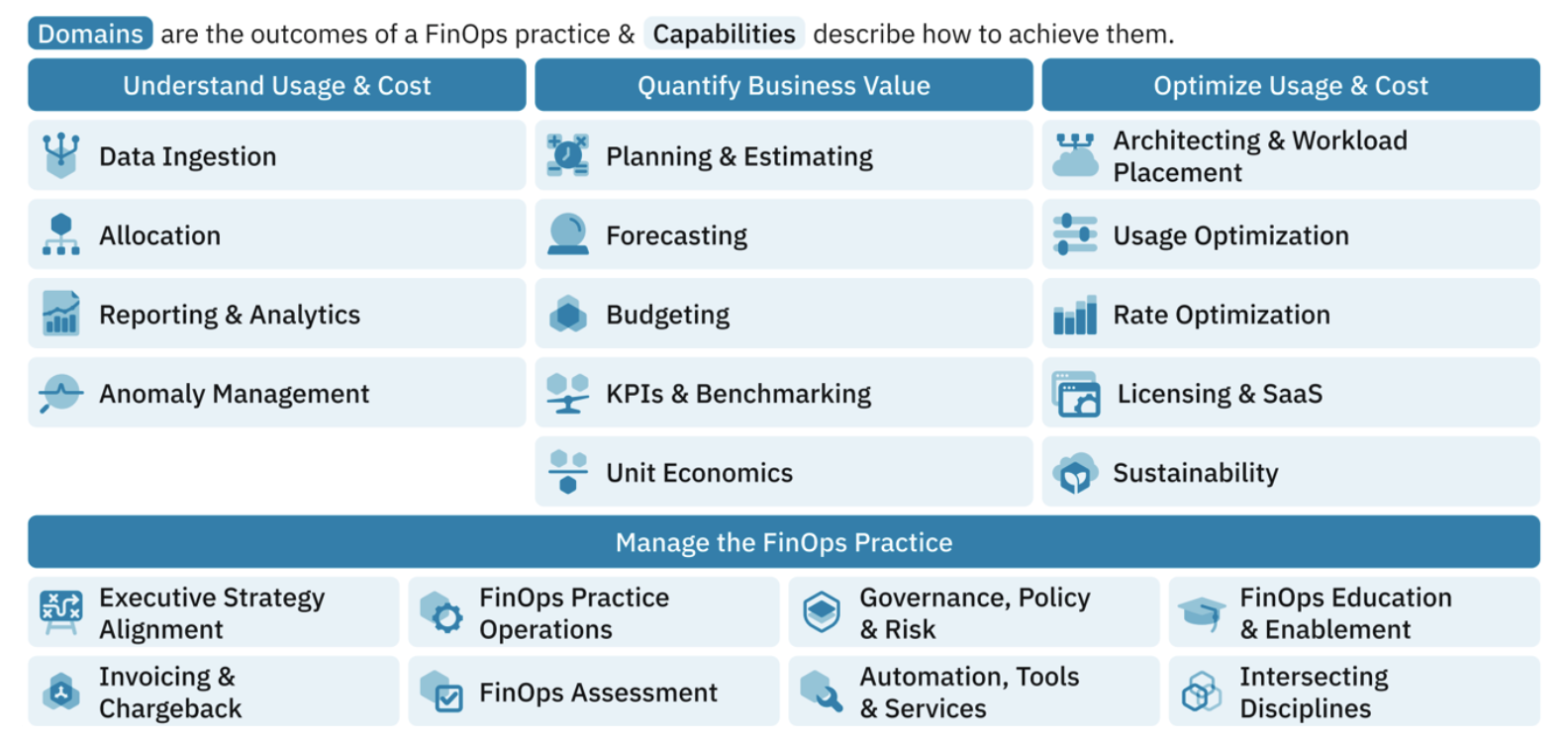
The FinOps Framework organizes its intended outcomes into four domains. These domains define the major areas where organizations must improve if they want to manage cloud spend strategically rather than reactively.
Understand Usage and Cost
The first domain is about visibility. Organizations need timely, transparent, and trustworthy cloud cost visibility before they can improve anything else. That means ingesting usage and billing data from multiple sources, allocating costs accurately, and making sure each stakeholder can understand the portion of spend that sits within their scope of responsibility. When cost data becomes clear and actionable, organizations can identify abnormal spikes, detect emerging inefficiencies earlier, and respond before spending issues turn into governance problems.
Quantify Business Value
Most companies can tell you how much they spent on cloud. Far fewer can tell you how much it costs to serve a single customer, process a transaction, launch a product feature, or support a revenue stream. Without that level of visibility, FinOps remains stuck in the language of cost reduction. It cannot meaningfully contribute to strategic investment discussions. The FinOps Framework emphasizes that cloud spending must be tied to business outcomes, growth metrics, or unit economics. Only then can organizations determine whether cloud investments are aligned with business priorities.
Optimize Usage and Cost
In many organizations, cloud cost optimization is still treated as a cleanup exercise: find unused resources and shut them down. That matters, of course, but the FinOps Framework defines optimization much more broadly. It includes architecture design, workload placement, usage optimization, rate optimization, licensing and SaaS optimization, and even efficiency and sustainability considerations. That breadth matters because it reinforces a key idea: cost optimization is about systematically reshaping the cost structure of the organization through technical, commercial, and operational levers.
Manage the FinOps Practice
Many FinOps initiatives lose momentum over time. The reasons are familiar: no dedicated ownership, no formal processes, weak enablement, and no governance model strong enough to sustain change. That is why the framework explicitly defines “Manage the FinOps Practice” as its own domain. FinOps is a long-term operating and cultural transformation.
Capabilities
If the four domains describe the outcomes an organization is trying to achieve, the 22 capabilities within those domains describe the practical abilities it needs to build. They are the operational muscles that allow FinOps to move from theory to execution across finance, engineering, and business functions.
It is worth noting that organizations do not need to become fully mature across every capability on day one. A more practical strategy is to identify the bottlenecks that most limit business value today, then prioritize the capabilities that will have the greatest impact.
FinOps Framework as the Navigation System for Cloud
Over the past decade, DevOps has helped organizations break down the barriers between development and operations. FinOps, on the other hand, aims to close the long-standing gap between technology and business.
That is exactly what the FinOps Framework offers. It gives enterprises a practical blueprint for moving from reactive cost management to proactive value governance. By aligning engineering, finance, product, procurement, and leadership around a shared set of data and objectives, organizations can stop treating cloud spend as an expense to be minimized and start leveraging it as a strategic investment to drive long-term growth.