_icon2_300_300.png?v=31818)

-
In the face of hybrid architectures that combine multi-cloud and on-premises environments, enterprises that focus solely on cloud FinOps often fail to capture the full picture of IT costs.
By conducting IT cost optimization assessments or business cases, organizations are able to assess their on-premises technology resources and licensing agreements from a holistic perspective. Through systematic methodologies—such as cost modeling, benefit simulation, and practical recommendations identification—enable enterprises to quantify their potential costsaving opportunities.

The Critical Need for a Holistic Perspective
For most people, FinOps means cloud cost optimization—such as analyzing billing allocation, resource rightsizing, and selecting the right pricing plans (On-Demand / Reserved Instances / Savings Plans). However, as enterprise IT architectures are no longer confined to a single environment, the scope of “optimization” must extend across multiple layers.
Today’s enterprise environments are typically hybrid architectures, which include on-premises data centers, multiple cloud platforms, and diverse licensed software. If FinOps analysis is conducted solely from a cloud perspective, it cannot fully capture the overall IT cost structure. Enterprises must also take into account the associated costs of on-premises technology environments.
As hybrid architectures become increasingly widespread, enterprises commonly face the following challenges when evaluating their IT cost structure:
- Rigid on-premises asset performance:
Enterprises often struggle to accurately define the “effective utilization rate” of on-premises resources. This leads to idle hardware continuously generating maintenance and operational costs, while lacking the elasticity to scale with business needs—ultimately resulting in sunk costs.
- Imbalanced software licensing mix:
Due to the complexity of on-premises and cloud licensing models, enterprises find it difficult to align actual business requirements with the number of licenses purchased. This can result in compliance risks or significant spending on unused licenses.
These hidden expenses are scattered across different platforms and licensing agreements. Enterprises that focus only on cloud costs often miss opportunities for overall IT performance optimization and may misjudge expansion or investment timing.
Approach to conducting IT Cost Optimization Assessment or Business Cases
IT cost optimization assessments or business cases use a systematic, repeatable methodology to integrate the cost structure of on-premises hardware, software, and licenses, etc. It provides quantifiable estimates to ensure every dollar spent is understood and accounted for. A typical assessment process includes four stages:
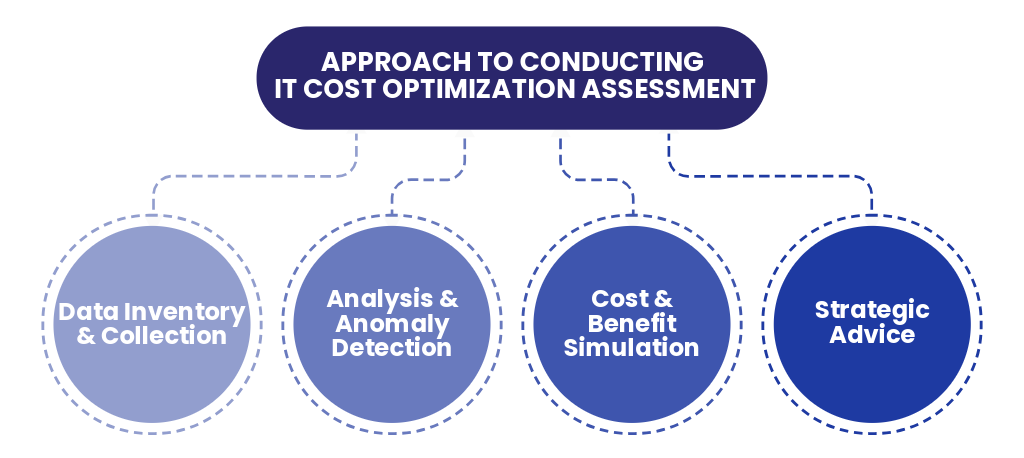
Data Inventory and Collection
Consolidate on-premises asset lists and license usage data to establish a complete inventory and current cost baseline, including hardware/software costs and maintenance cycles, achieving cost transparency.
Analysis and Anomaly Detection
Perform quantitative and qualitative data analysis to identify idle resources, over-provisioning, and abnormal usage patterns. This helps uncover potential license waste or compliance risks, eliminating unnecessary expenses.
Cost and Benefit Simulation
Model different adjustment scenarios—such as migrating on-premises workloads to the cloud or converting licenses—to forecast savings potential and ROI cycles, translating predictions into manageable financial expectations.
Strategic Recommendations
Based on business objectives, develop optimization strategies and plan phased execution steps with measurable KPIs.
Electrum Helping General Life Biotechnology Co.,LTD to identify up to 50% in Potential IT Cost Savings
For General Life Biotechnology Co.,LTD, Electrum’s consulting team applied the Optimization Assessment approach to conduct a comprehensive review of its IT environment, focusing on seven cost dimensions (including resource allocation, utilization, contracts, and licensing models). The results were significant:
-
Identified up to 50% potential IT cost savings opportunities
-
Optimized licensing and cloud resource strategies to achieve rightsizing
-
Enabled the enterprise to continuously monitor IT investment effectiveness with data-driven
This outcome demonstrates that when enterprises combine cost savings with value management, IT transforms from a cost center into an engine for innovation.
For a full understanding of the assessment methodology and implementation details, please refer to the complete case analysis: General Life Biotechnology Co., Ltd., GLB.
Electrum Delivers Comprehensive Optimization Assessment and Business Case
Electrum’s consulting team combines practical experience with standardized methodologies to help enterprises perform a comprehensive review across multi-cloud and on-premises environments. Our IT cost optimization assessments or business cases go beyond cloud billing and extends to the entire IT landscape, including:
-
On-Premises Environment Assessment: Analyze server utilization, hardware refresh cycles, and maintenance costs, while assessing workloads suitable for cloud migration.
-
Licensing Optimization: Audit license counts and actual usage, identify overlaps or idle items, and recommend licensing models that maximize business value.
-
Long-Term Governance Framework: Provide sustainable performance and cost governance strategies to ensure optimization results are effectively implemented.
By conducting IT cost optimization assessments and business cases, we enable organizations to step out of a single angle perspective and uncover a complete and accurate picture of their cost structure.